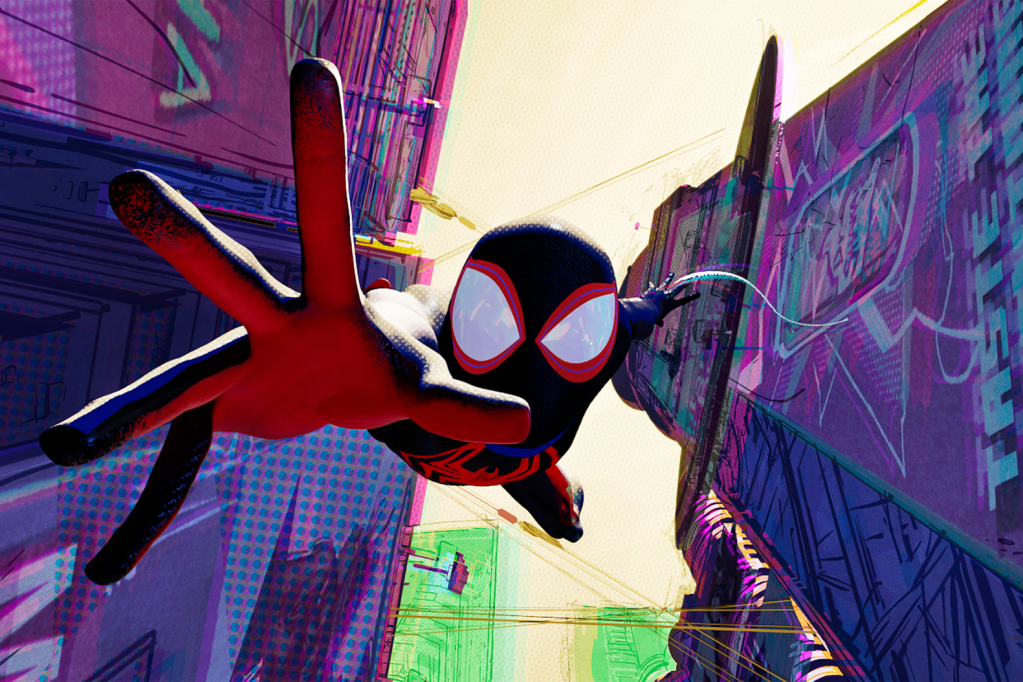
The character of Miles Mirales had some big shoes to fill in the limelight absence of the popular and profitable Peter Parker, but thankfully he has his Air Jordan’s on, and gives a fresh feel to the Spider-Man story.
2018’s Spider-Man: Into the Spider-Verse offered a refreshing take on the successful superhero. Whilst Tom Holland was web-slinging elsewhere in the MCU, the directing partnership of Bob Persichetti, Peter Ramsey and Rodney Rothman really injected the comic book aspect into their visually divergent project. Using bursts of different colours and art styles, Into the Spider-Verse optimised its optical lens by giving every frame its own separate identity.
Fast forward a few years and Miles (Shameik Moore) has returned, with his character facing more dilemmas and dangerous scenarios. With mentor Peter B. Parker (Jake Johnson) and friend Gwen Stacy (Hailee Steinfeld) retuning to their own universes after the collapse of the collider in the previous movie’s finale, Miles learns to juggle his superpowers whilst navigating his way through school and his overly nurturing parents. With a new supervillain, the self-titled Spot (Jason Schwartzman), terrorising Mile’s world though, he is reunited with Gwen accompanied by a handful of other Spidey’s who we discover are a part of a universal uniting Spider Society headed by Miguel O’Hara/Spider-Man 2099 (Oscar Isaac).
Spider-Man: Into the Spider-Verse set up a great precedent that could be followed for future sequels to profit handsomely from. With a new directing team of Jaoquim Dos Santos, Kemp Powers and Justin K. Thompson heading the project, they carry forward much of what worked with Miles’ first journey. There’s still a lot of heart to its story, and the voice acting is on par with some of the best we’ve seen in some years, but with the added benefit of a multiverse (yes, we’re doing that again), the art style can really flourish as it chaotically jumps through different worlds and ideas like a Pablo Picasso mural of endless possibilities. This time even adding a touch of live-action for some classic call-backs was a sweet surprise.
Every frame could be frozen and deeply analysed, and having your eyes working against one another to pick up on every creative visual decision is a sensation most movie’s cannot claim. With each ‘Spidey’ and new world we wonder through we get to witness the creative designers really throw the kitchen sink with creative freedom and expression seemingly playing a huge part.
Whilst the absence of Spider-Man Noir (Nicolas Cage) and Spider-Ham (John Mulaney) is apparent, the arrival of anti-authoritarian Hobie Brown/Spider-Punk (Daniel Kaluuya) and ‘Mumbattan’ protecting Indian Spider-Man, Pavitr Prabhakar (Karan Soni), are rightful replacements.
Miguel is menacing and mysterious, and as the story progresses we learn that he’s really the big bad of the first of this two-parter. His methods are strict to his protection of the multiverse, which Miles merely continues to jeopardise. Spot’s story arc is played as a more comically curated decision but creates a better bridge between the two movies. His role is designed to have deeper involvement in the final instalment which is scheduled to release next year.
The relationship between Miles and Gwen is further explored, and the screen time is more fairly distributed without completely pulling Miles out of the limelight. After all, Miles is one of the more memorable protagonists in recent years and the fact that he’s been given this platform is a huge win for the Marvel brand.
Outside of its visual improvements and care to character development, I consider Across the Spider-Verse to be a slight downgrade, but it’s really only marginal. The purposefully more poppy and prominent soundtrack through its first outing left a much bigger impact and its tighter narrative made it easier to follow, but Across the Spider-Verse’s ambition is admirable and gives Marvel another big hit.
 Critical Clay